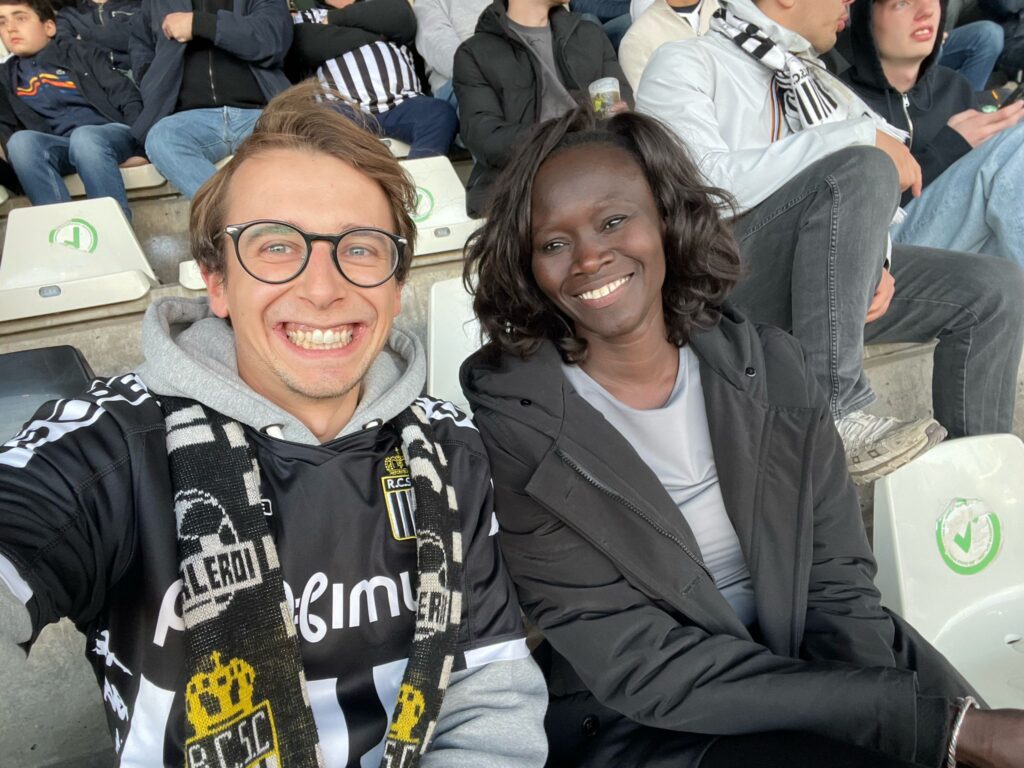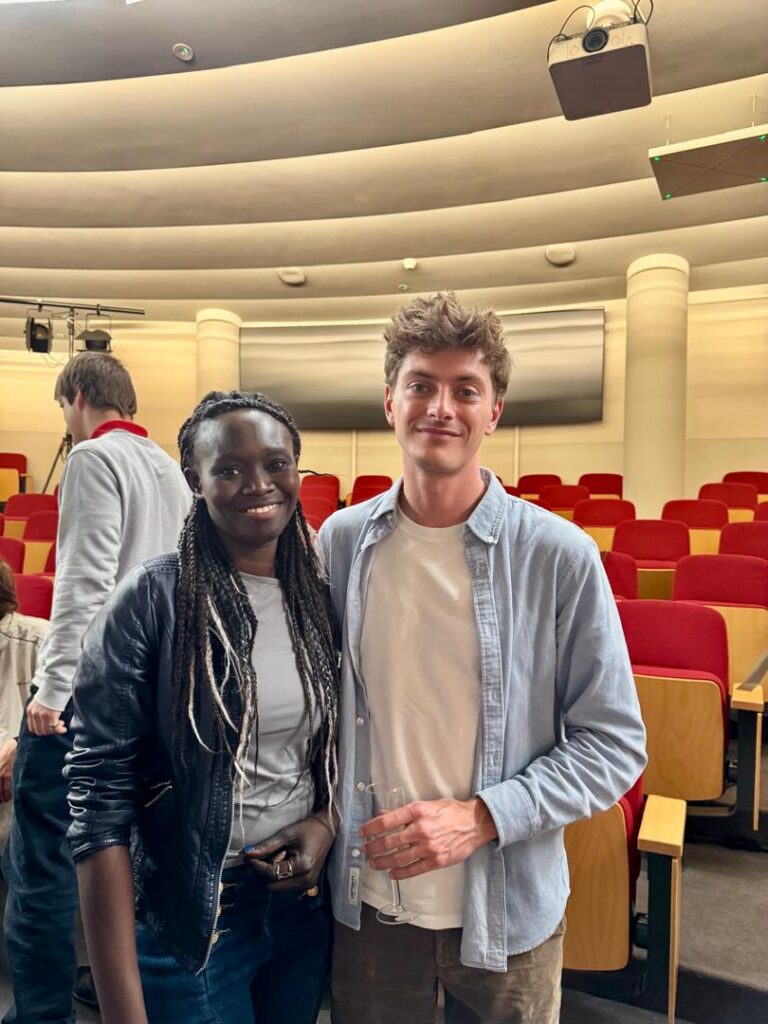
Thanks to an ARES mobility program, Quentin, a second-year Master’s student in Press and Information, and May, a Senegalese journalist, had the opportunity to exchange perspectives on journalism between Brussels and the RTC in Pikine. The experience proved to be both immersive and deeply insightful.
Less than a year ago, Quentin and May had never met, yet they were about to embark on a journey that would challenge their professional assumptions.
Quentin, then studying in a Master’s program in Press and Information, was preparing to leave for Senegal, while May, a journalist at Radio Oxyjeunes, was settling into life in Brussels.
Supported by ARES (Academy of Research and Higher Education), these exchanges created a unique opportunity to compare two ways of practicing journalism: one shaped by Belgian audiences, the other rooted in the newsroom of Pikine.
Learning to “slow down” at the RTC
As part of an ARES travel grant, Quentin completed a three-month internship in Senegal, where he joined the Community Radio and Television (RTC) in Pikine, a network bringing together 133 local media outlets. Far from the fast-paced news cycle typical in Europe, he discovered a more measured rhythm. “We rush less, but quality does not suffer,” he explained upon returning. At the RTC, editorial decisions are made without haste, often at the end of the day, allowing journalists to focus on stories that closely reflect community concerns, such as fish scarcity, food insecurity, or personal life stories.
However, the internship also presented significant technical challenges. Without an established network of contacts and facing a partial language barrier, Quentin had to rely on his own initiative in the field. His experience culminated in the production of a full magazine piece created entirely on a smartphone, demonstrating that a minimalist approach can still deliver high-quality journalism.
May’s immersion in Brussels
At the same time, May was discovering IHECS and life in Belgium. Her first days were marked by the challenge of finding her bearings in a city where many streets seemed alike, but she was quickly welcomed by fellow students. “I felt they saw us as equals, without judgment,” she recalls.
Beyond the sense of hospitality and safety she particularly appreciated in Brussels, May used the semester to strengthen her journalistic skills and knowledge. Through courses in narratology and writing workshops led by Wilson Fache, she explored formats such as narrative podcasts and digital storytelling through carousels. She hopes to introduce these tools in her newsroom in Senegal to help modernize the way information is shared.
What remains today
One year later, the impact of their experiences still resonates. May returned home with the conviction that journalism is a universal profession, open to everyone. Quentin, for his part, came to understand that the role of a journalist is deeply shaped by context. What matters in Brussels may not carry the same urgency in Pikine, and vice versa.
Their journeys highlight the value of international mobility as a powerful learning experience. It encourages journalists to compare practices, challenge assumptions, and refine their professional identity.